
Boundaries, Beginnings and Being Held
Transitions are hard...

Every January First, there’s a collective insistence that something has begun.
I had to get a new calendar. I had to change my passwords. I always try to refresh my routines: fresh start, clean slate, new year.
And yet, if you’re sensitive, it rarely feels that clean.
There’s often relief in the idea of a beginning - that “new planner” feeling. Some comfort in believing that we can step across a threshold and be different on the other side. But lived experience is messier than that. Transitions take time. They often ask to be held longer than we plan for.
This is why I love the space between January 1st and the Lunar New Year. It acknowledges something we all know in our bodies already: change needs time. Orientation takes repetition. Meaning arrives in layers.
For many of us, this in-between space is emotionally complex. We’re noticing ourselves again. Not just what’s happening out there, but what’s moving in here. Both are real. Both are happening at once.
And sometimes the hardest part isn’t that we can’t handle it, it’s that we don’t want to face it alone.
The Relief of Structure
There is a deep, nervous-system-level relief in knowing when something begins and when it ends. From here we go to clocking out.
This is what boundaries offer when they’re working properly, the restriction offers rest. They create a container where attention can soften instead of staying hypervigilant. They allow us to show up more fully because we’re not bracing for everything, all at once.
The idea that you should be able to scroll social media and take every emotional hit the algorithm throws at you is absurd! So much suffering comes from insisting we don’t need things.
That we don’t need reliable friends.
Or medication.
Or regular time in nature.
Or alarms for when our internal sense of time gets fuzzy.
It’s not an emergency to need things. It’s not survival mode to do what you have to do to feel okay. It’s maintenance.
Survival mode turns maintenance into name-calling. It frames care as weakness, dependence as failure, support as something to outgrow. But caring for yourself isn’t just about survival, it’s how systems stay functional.
You can’t grow into someone else. You can only be more of who you were born as, continuing.
You are not the content of your life, the events, the losses, the breakthroughs.
You are the person those things happened to.
Every single one of them happened to you, growing you.
Blooming Isn’t the Whole Story
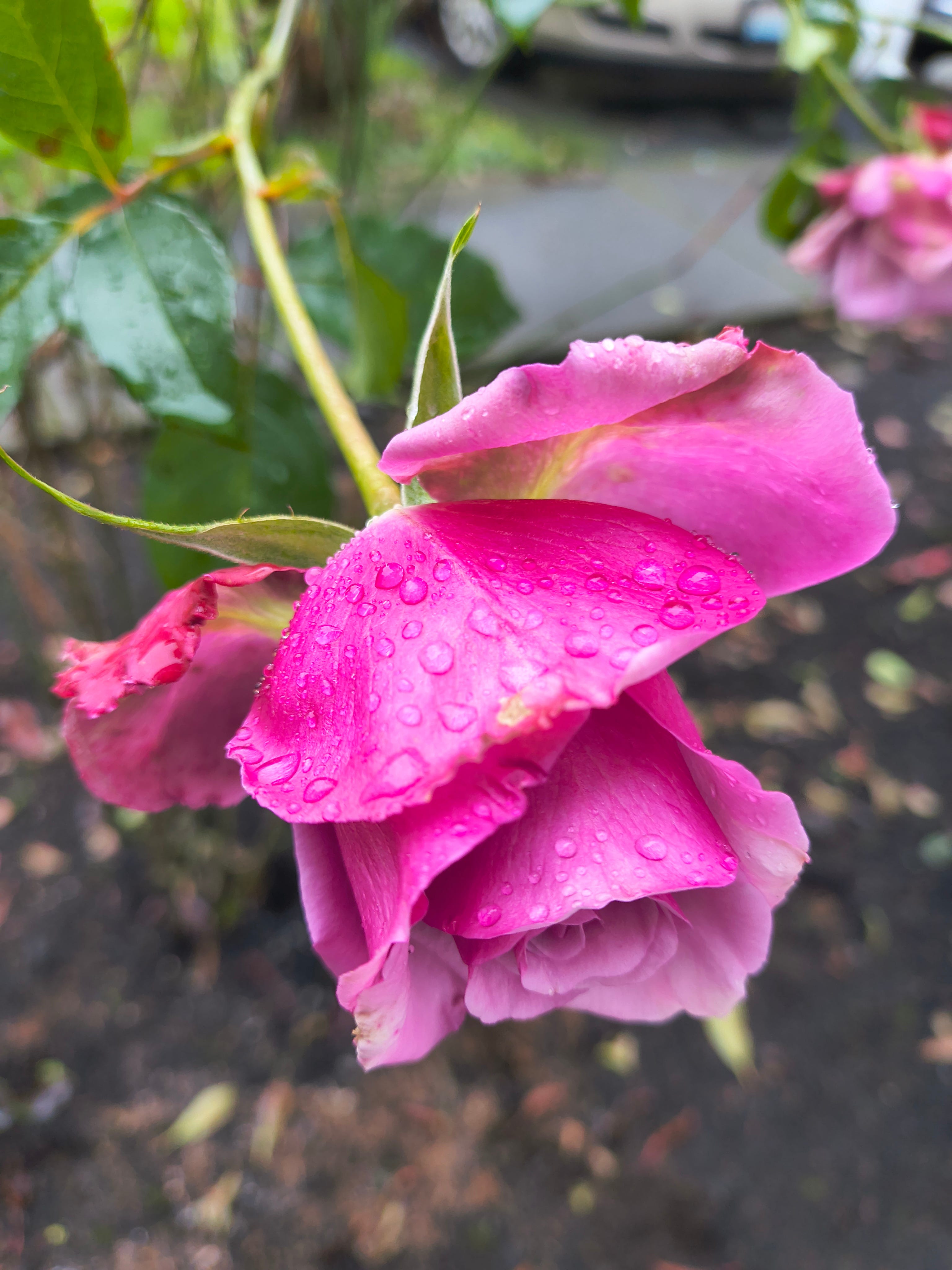
Every rose on a rose bush is different. Just like every season of your life where you’re allowed to bloom. It feels like I’m a totally different person than I was 5 years ago, 10 years ago. If you knew me as a kid but haven’t kept up with me, you wouldn’t know me at all today. Toni Morrison once said “Sometimes you don't survive whole. You just survive in part. But the grandeur of life is that attempt. It's not about that solution. It is about being as fearless as one can, and behaving as beautifully as one can, under completely impossible circumstances.”
A full life doesn’t only produce flowers. It also grows thorns. Branches. Roots.
You will have breakthrough after breakthrough and that still won’t be the entirety of your life. You continue. There are long stretches of integration, of maintenance, of waiting, of ordinary care.
Trusting this unfolding can be hard.
Sometimes it feels like you’re making yourself miserable by staying with painful feelings. Other times it feels like you’re avoiding the future by enjoying the present too much. These aren’t personal failures, they’re patterns. And patterns only reveal themselves over time.
Your patterns are distinct to you.
And - this part - they are also profoundly human.
Have you ever thought you were having a completely unique experience, only to go online and discover entire communities who say, Oh, yeah, me too.
There’s a rhythm to this - alone and then family, isolated and then understood. It is part of being human.
Self-compassion rests on three things:
acknowledging feelings (mindfulness), emotional warmth (kindness), and connection to common humanity.
The poet Andrea Gibson says sometimes the most healing thing we can do is realize other people feel this too.
You are not alone in any experience you have ever had.
And.
Your experience is uniquely yours.
Forgetting and Remembering
If you don’t know the impact of what you’ve been through, the world will never receive the wisdom of your experience. No one knows what it was like for you to go through all that you’ve been through until you tell us.
So many people come to talk to me believing I’ll have some special insight. But when we sit together, I ask about your story. I listen carefully. And then I reflect back the wisdom you shared with me.
Almost every time, there’s a pause.
“Oh,” you say.
“I do know that. I forgot.”
That cycle - forgetting and remembering - is not a flaw or memory issues. It’s the sweetness of life.
Did you know squirrels don’t reliably remember where they bury their nuts? They look for a good place, check to see if something is already there, and trust the process.
I do something similar in public spaces. I’ll think, I really wish there were a trash can nearby and often, there is. Not always immediately, not always right in front of me. Sometimes I notice the absence first. But if I stay with the need, something with structure eventually emerges.
Every single time.
Care Has Edges
I love doing sessions outside because I get to share the emotional labor with the wind.
So many moments of deep loneliness I’ve witnessed have been interrupted by a bird, a song drifting past, a tree moving unexpectedly, a text from someone who loves the person sitting across from me.
Once, in the middle of a mindful moment, a client’s phone alarm went off. Startled us both. When they checked it, the reminder simply said: You are loved.
They had set it because they forget sometimes. And it worked.
We just had to hold hands and breathe together to get through until the next reminder.
Care has edges. Not everything needs to be available all the time.
This is what allows us to dance together, to enjoy one another without exhaustion. Timing matters. Trusting timing matters.
There’s no band keeping time. It’s the ocean. The sun. The moon.
There is something deeply steady about that flow. I can’t control it, but I do have agency. I can turn toward it. Move with it. Use it instead of fighting it.
That takes practice. And often, it takes support.
Adequate food. Clothing that fits my body and the weather. Safe housing. Enjoyable activity. Sometimes medication. Sometimes assistive devices. Sometimes other people helping.
The important thing isn’t what you need.
The important thing is that we can stay together.
You in your house.
Me in mine.
Together on the same planet.
Staying with yourself, knowing that’s enough, that’s the practice.
And you don’t have to do it alone.
If you ever need it, I hold space like this for people virtually. You may not need intensive therapy, but you do deserve ongoing contact with yourself.